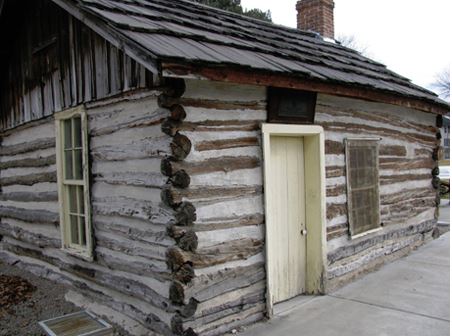
 The O’Farrell Cabin was the first permanent dwelling in Boise. Its builder, John Andrew O’Farrell, grew up in Tyrone Co., Ireland. He made his first visit to America in 1843, when he was 20 years old. Upon his return home, he served in the British Navy and won a Medal of Valor in the Crimean War. His heart for adventure and dreams of striking it rich soon lured him back to the U.S., where he prospected for gold in California, Oregon, Washington, Montana, Nevada, Arizona, Colorado, Utah, New Mexico, and Idaho. In 1859, he wed an Irish immigrant widow named Mary Anne Chapman Lambert. Together, they traveled by wagon to the Boise Valley in 1863.
In June, John cleared land on what is now Fort Street and built the cabin out of cottonwood trees, filling in the chinks with small branches and clay. The inside walls were covered with fabric and the dirt floor with wooden planks. On July 7th, just a few weeks after the O’Farrell’s cabin construction was complete, Thomas Davis and nineteen other settlers platted the City of Boise. It was made up of 10 blocks split evenly down Main Street from 10th to 5th Street and fronting Idaho, Main, and Grove. Following the initial plat the city grew quickly, and within four short years had expanded to 140 blocks.
The O’Farrells were prominent citizens of Boise. John was one of the first investors in the New York Canal and also served in the Territorial Legislature. Mary was responsible for providing the first Catholic services in Boise, which were held in the O’Farrell cabin. Also, they donated land for the first Catholic Church to be built in Boise. Together they raised seven children and adopted seven more. Eventually, they moved out of the cabin and into a house. In the 1880s, they lived on Hays St., and John worked as a blacksmith. By 1891, John & Mary had moved to a large brick house on the corner of 4th and Franklin, and John was employed as a quartz miner.
Mary passed away in May of 1900 at the age of 60. John died in October of that same year. They were both buried in the Morris Hill Cemetery. In 1910, the O’Farrell children donated the cabin to the Daughters of the American Revolution, who had it moved across the street onto land given by the Army for the structure’s protection and preservation. In 1957, ownership passed to the Sons and Daughters of the Idaho Pioneers who then passed it to the City of Boise.
In 1999, third-generation Boise architect Charles Hummel along with the Columbian Club (one of the city's oldest service clubs) organized a drive to refurbish the cabin. The city's Millennium Fund also contributed. In 2002, at a cost of $51,000, craftsmen restored the cabin to its 1912 condition, down to its roof shingles and original paint colors.
More than 150 years after its construction, the cabin still stands on Fort Street between 4th and 5th and is available for the public’s viewing pleasure.
Share this with your friends


208-861-5639
Real Estate Company
Jan. 20, 2017
The History of the O'Farrell Cabin
Posted in
Local History
no comments yet
Please enable Javascript to comment on this blog
TripleCord Real Estate
Meet Our Agents
:format(webp):quality(80)/u.realgeeks.media/triplecordrealestate/TripleCord_Agents_08-2026.jpg)
"We couldn't be more impressed by the dedicated, professional, custom-tailored services we received from TripleCord Real Estate when we decided it was time to sell our home and buy a new home." ~The Stichkas
:format(webp):quality(80)/u.realgeeks.media/triplecordrealestate/E-News_Button_TripleCord.jpg)
:format(webp):quality(80)/u.realgeeks.media/triplecordrealestate/EqualHousingLogo_2.png)